

More than 1,000 visitors explored the Collection on its first public day in its new home
From the moment the doors opened at the Bate Collection of Musical Instruments on 25 April 2026, queues formed outside. It was the first time the public had been able to visit the Bate since its move from St Aldate's to the Schwarzman Centre for the Humanities. Around 12,000 people came to the Centre for its Open House, with more than 1,000 visiting the Bate throughout the day.
The Collection was busy from the start. Visitors moved between Resonant Histories, performances and handling sessions, with families, students, musicians and members of the public spending time exploring the new galleries. Some stayed for several events, while others dropped in and discovered the Collection as part of their visit to the Centre.
For Dr Emanuela Vai, Head of the Bate Collection and curator of Resonant Histories, the reopening was an opportunity to introduce visitors to the Collection in a new setting and to explore instruments through their materials, craftsmanship, histories and sounds.
Music was central to the day. Graduate Music student Zack Di Lello performed from the balcony of the Great Hall on the Simon Beale Trumpet, playing a piece he had composed specifically for the instrument. The trumpet once belonged to Simon Beale, State Trumpeter to Oliver Cromwell and Charles II. It was an apt way to mark the reopening: an instrument with a history stretching back centuries being used to make new music in the Bate's new home.
Elsewhere, visitors heard historical keyboards presented by Maria Razumovskaya, Director of Performance at the University of Oxford, and historical horns performed by Anneke Scott, an internationally leading exponent of historical horn playing. The harmonium played by graduate student Saad Barcha was once owned by Ustad Nusrat Fateh Ali Khan, connecting the Collection with the rich musical tradition of qawwali.
But the day was not only about watching and listening. The handling sessions, led by Isabelle Carré, Education and Outreach Officer at the Bate, gave visitors the opportunity to get much closer to the instruments. Children played a viola da gamba and replicas of the Simon Beale Trumpet and a serpent. Families gathered around the instruments, while the serpent, Tibetan Dun Chen and theremin drew particular attention from visitors curious to discover how these unusual instruments looked, felt and sounded.
The programme ended with an appearance by internationally renowned thereminist Lydia Kavina. Her performance provided a fitting reminder of the extraordinary range of instruments held by the Bate, from instruments with centuries of history, to one of the most unusual inventions of the 20th century.
The Collection has now opened its doors in its new home, where its instruments can continue to be studied, played and shared with the public.
The Bate Collection is open every Monday and Thursday, 2-5pm, and admission is free.
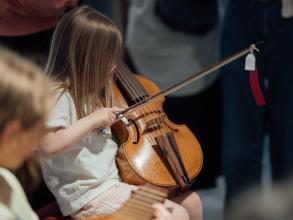
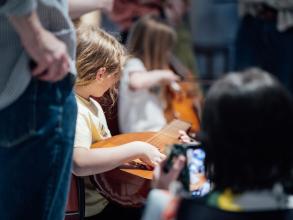
Girl playing the Lute at the Bate Collection of Musical InstrumentsBate Collection of Musical Instruments, Schwarzman Centre of the Humanities, University of Oxford
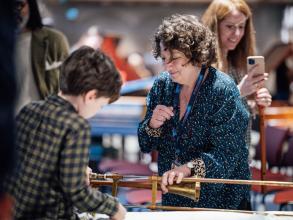
Boy looking at instrument at the Bate Collection of Musical InstrumentsBate Collection of Musical Instruments, Schwarzman Centre of the Humanities, University of Oxford